Series Overview
👉 [Part 1: AI, Blockchain, and Cloud: Who Actually Does What?](#part-1-ai-blockchain-and-cloud--who-does-what)
👉 [Part 2: Why Fully Decentralized AI Is (Mostly) a Myth](#part-2-why-fully-decentralized-ai-is-mostly-a-myth)
👉 [Part 3: Web3 Data -> Cloud ML Pipelines (Spark in Practice)](#part-3-how-cloud-ml-pipelines-power-web3-analytics)
👉 [Part 4: AI for Blockchain Fraud & Anomaly Detection](#part-4-ai-for-blockchain-fraud--anomaly-detection)
👉 [Part 5: Smart Contracts + AI Agents: Autonomous Systems](#part-5-smart-contracts--ai-agents)
👉 [Part 6: Auditable AI: Using Blockchain for Trust & Governance](#part-6-what-comes-next-predictions)
---
Part 1: AI, Blockchain, and Cloud: Who Actually Does What?
Introduction
AI, blockchain, and cloud computing are often discussed as if they are competing paradigms. In reality, they solve quite different engineering problems. Confusion arises when teams try to force one technology to do the job of another. When that happens, systems get slower, more expensive, and harder to audit.
This article establishes a clear mental model for how these systems should work together in production.
The Core Responsibilities
Layer | Responsibility | Why It Exists |
|---|---|---|
AI | Prediction, classification, extraction | Intelligence |
Blockchain | Immutability, ordering, verification | Trust |
Cloud | Compute, storage, orchestration | Scale |
Key principle:
Any architecture that violates these boundaries will fail on cost, performance, or maintainability. Treat the boundaries as contracts, not suggestions.
Why Blockchain Is Not a Compute Engine
Blockchains are:
- Slow
- Deterministic
- Expensive per operation
Consensus trades speed for verifiability, which is exactly the opposite of what inference needs. They are excellent for verifying outcomes, not generating them.
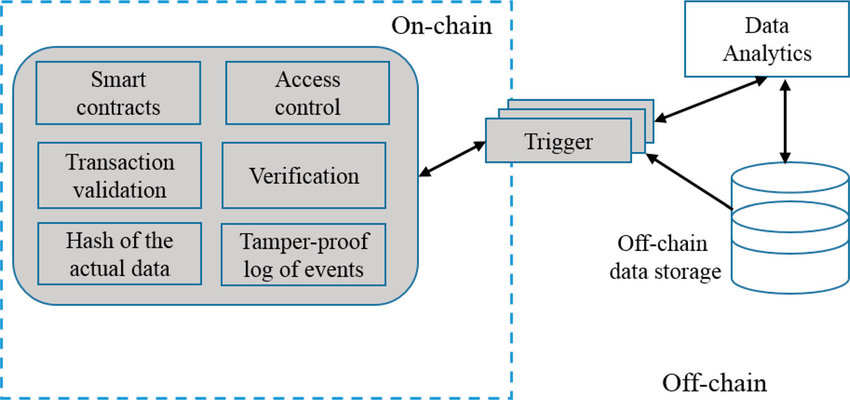
Practical Hybrid Architecture
What works in real systems:
- AI inference runs off-chain (cloud CPUs/GPUs)
- Outputs are hashed
- Hashes and metadata are stored on-chain
- Smart contracts verify integrity
This keeps heavy compute off-chain while preserving an auditable trail.
Minimal Code Example
Hashing the output creates a commitment that can be verified later without revealing the raw data.
AI Inference (Cloud)
import hashlib, json

output = {"risk": 0.91, "label": "high"}
hash_value = hashlib.sha256(json.dumps(output).encode()).hexdigest()
Smart Contract (Verification)
mapping(bytes32 => bool) public verified;

function register(bytes32 h) public {
    verified[h] = true;
}
When This Pattern Makes Sense
- Financial risk scoring
- Fraud detection
- Model governance
- Compliance-driven AI
Closing Thoughts
AI decides.
Blockchain verifies.
Cloud scales.
Trying to collapse these roles is an architectural mistake. Keep the boundaries crisp and the system stays debuggable.
📚 Further Reading
---
Part 2: Why Fully Decentralized AI Is (Mostly) a Myth
The Promise vs Reality
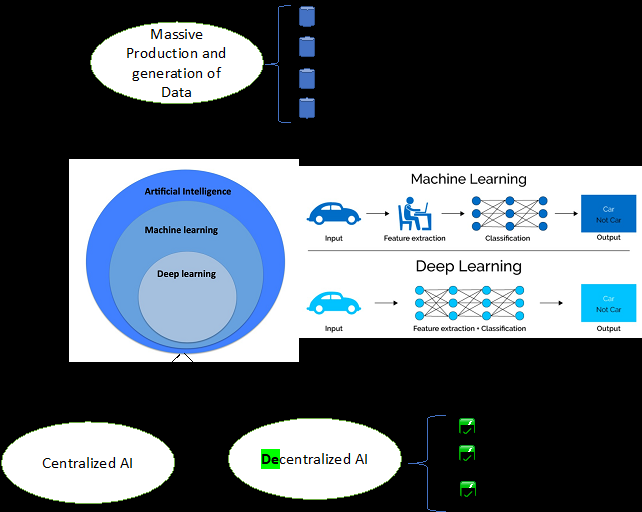
Decentralized AI promises trustless, censorship-resistant intelligence. The problem is physics and economics, not ideology. At scale, bandwidth, scheduling, and power costs dominate the design.
Hard Constraints Engineers Cannot Ignore
Constraint | Why It Breaks DeAI |
|---|---|
GPUs | Scarce, expensive, centralized |
Latency | On-chain is not real-time |
Cost | Inference at scale is costly |
Tooling | ML stacks assume cloud |
These constraints show up immediately once you push beyond toy workloads, especially when you need consistent latency.
The GPU Problem
Training and inference require:
- High-bandwidth memory
- Fast interconnects
- Centralized scheduling
This naturally pushes AI workloads toward cloud hyperscalers.
What Actually Works
- Centralized inference
- Decentralized verification
- Token incentives for contributors
- Cryptographic proofs of output
The pattern is hybrid by design: compute where it is efficient, and verify where it is trust-minimized.
🧩 Case Study: Decentralized Inference Marketplace
A startup attempted token-incentivized GPU nodes. The result was inconsistent uptime, latency spikes, and a centralized fallback for reliability. Incentives helped utilization, but not the tail latency that production systems care about.
---
✅ Implementation Checklist
- [ ] Measure GPU economics
- [ ] Compare latency vs block time
- [ ] Separate governance decentralization from compute
---
⚖️ Tradeoffs
Model | Pros | Cons |
|---|---|---|
Centralized | Reliable | Trust needed |
Fully DeAI | Ideologically pure | Unstable |
Hybrid | Practical | Slightly complex |
Engineering Reality (Solidity)
mapping(bytes32 => address) public inferenceProducer;You do not decentralize GPUs. You decentralize trust in results.
Conclusion
Decentralized AI is not dead, but it will always be hybrid in production.
📚 Further Reading
- ZKML research papers
- Rollup architecture discussions
---
Part 3: Web3 Data -> Cloud ML Pipelines (Spark in Practice)
Why Blockchain Data Is Perfect for ML
Blockchains are:
- Append-only
- Time-ordered
- Public
- Behavior-rich
This makes them ideal for feature engineering because you can derive rates, burstiness, and counterparty diversity directly from the ledger.
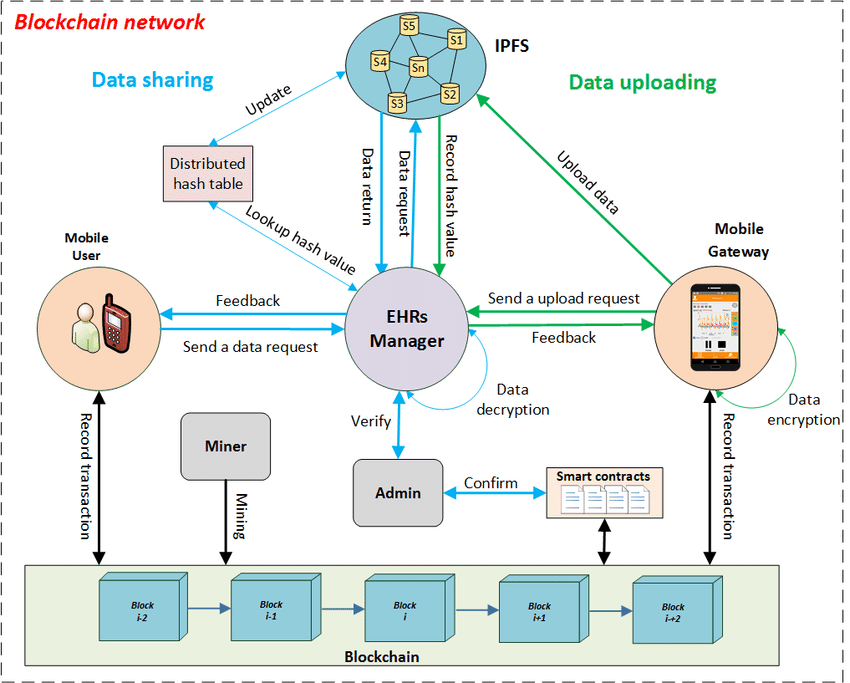
Reference Architecture
- Blockchain Node
- -> S3 (raw JSON)
- -> Spark (ETL + features)
- -> ML model
- -> Predictions on-chain
Treat the chain as the source of truth and let the cloud absorb the heavy compute.
PySpark Example
df = spark.read.json("s3://eth/tx/")

features = df.groupBy("wallet").agg(
    count("*").alias("tx_count"),
    sum("value").alias("total_value")
)
Optional: commit scores on-chain (valid Python)
import hashlib, json

# w = wallet, s = score, ver = model version
payload = json.dumps({"wallet": w, "score": s, "model": ver}, sort_keys=True).encode()
commitment = hashlib.sha256(payload).hexdigest()
This keeps outputs auditable without pushing full inference on-chain.
ML Applications
- Wallet risk scoring
- Whale detection
- Bot identification
- Market behavior analysis
Why Cloud Wins
Only cloud platforms provide:
- Elastic compute
- Distributed storage
- Mature ML tooling
Closing
Web3 generates data. Cloud turns it into intelligence, and the chain preserves the audit trail.
📚 Further Reading
- MLflow Getting Started
- Apache Spark SQL Performance Tuning
- Apache Spark Tuning Guide
- Databricks Optimization Guide (Spark/Delta best practices)
---
Part 4: AI for Blockchain Fraud & Anomaly Detection
Fraud Is Behavioral
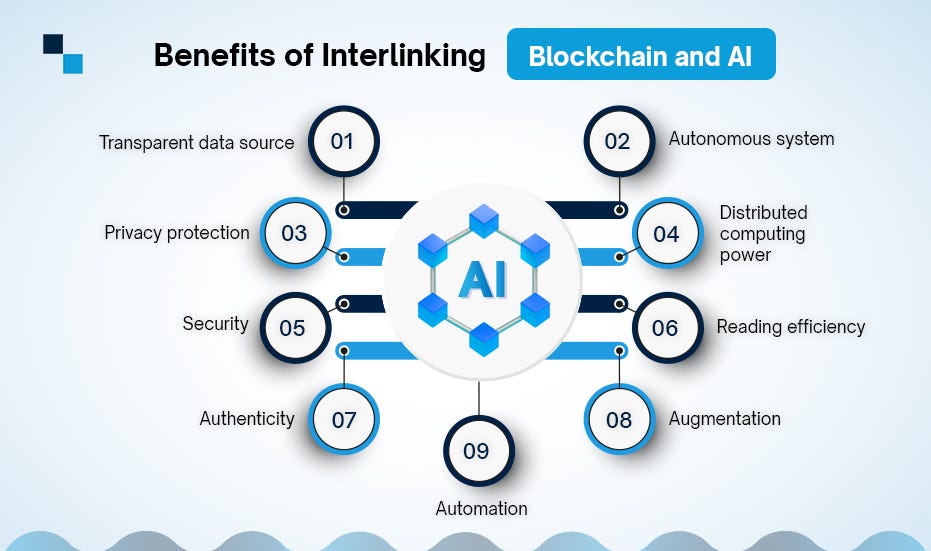
Most blockchain attacks do not break cryptography. They exploit human and system behavior. That means detection is about spotting deviations from normal activity, not finding a single magic signature.
Common Fraud Patterns
- Wash trading
- Sybil wallets
- Bot farms
- Flash-loan abuse
Feature Engineering Examples
Feature | Signal |
|---|---|
tx_rate | Automation |
counterparty_entropy | Wallet diversity |
value_variance | Manipulation |
These features are cheap to compute and hold up across chains.
Baseline anomaly detection (continuous scores; features defined)
import numpy as np
from sklearn.ensemble import IsolationForest

features = np.array([
    [10,  1.2, 0.5],
    [500, 80.0, 2.1],
    [20,  2.0, 0.7],
], dtype=float)

model = IsolationForest(contamination=0.01, random_state=42)
model.fit(features)

scores = model.decision_function(features)
risk_scores = -scores
Use the continuous scores to rank alerts before applying thresholds.
Blockchain Integration
- Store scores on-chain
- Trigger smart-contract rules
- Maintain immutable audit trail
On-chain writes should be sparse: store decisions or summaries, not every feature.
Conclusion
AI detects. Blockchain enforces.
📚 Further Reading
- Isolation Forest (Liu, Ting, Zhou, 2008) — PDF
- Rekt News (exploit writeups)
- De.Fi REKT Database (exploit index)
- Ronin bridge security breach postmortem
- Poly Network hack analysis (Elliptic)
---
Part 5: Smart Contracts + AI Agents: Autonomous Systems
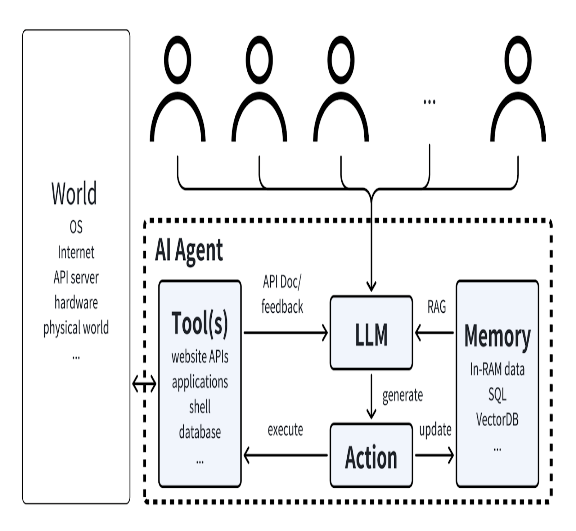
Smart contracts are deterministic enforcement engines. AI agents are adaptive decision engines. Combine them safely by treating agent output as untrusted input and enforcing guardrails on-chain. The chain should enforce invariants, not run the model.
🧩 Case Study: Autonomous Rebalancing With Hard Caps
An AI agent proposes rebalances off-chain. On-chain contracts enforce max exposure, max daily turnover, and an emergency pause. The guardrails keep failure modes bounded even when the model is wrong.
---
Architecture patterns
Proposal → Validate → Execute
1) Agent proposes an action (signed payload)
2) Contract validates caps/allowlists/thresholds
3) Contract executes and emits audit events
Oracle / attestation pattern
Contracts accept signed risk attestations from authorized signers and enforce freshness windows + nonces. This keeps decisions off-chain while preserving accountability.
---
Guardrails (Solidity)
Exposure caps + risk threshold (baseline)
uint256 constant MAX_EXPOSURE = 1_000_000;

function executeTrade(uint256 exposure, uint256 riskScore) external {
    require(exposure <= MAX_EXPOSURE, "Exposure too high");
    require(riskScore < 80, "Risk too high");
    // ...trade logic...
}
Rate limiting (prevent fast mistakes)
uint256 public lastTradeTs;
uint256 constant MIN_DELAY = 10 minutes;

function executeTradeDelayed(...) external {
    require(block.timestamp - lastTradeTs >= MIN_DELAY, "Rate limited");
    lastTradeTs = block.timestamp;
    // ...
}
Circuit breaker / emergency pause
bool public paused;

modifier notPaused() {
    require(!paused, "Paused");
    _;
}

function setPaused(bool v) external /* onlyGuardian */ {
    paused = v;
}
---
Failure modes and mitigations
Failure mode | Mitigation |
|---|---|
Malicious/incorrect agent output | caps, allowlists, staged rollout |
Oracle compromise | multiple oracles, medianization, bounds checks |
Front-running / MEV | TWAP, slippage caps, commit-reveal |
Reorgs / finality | confirm-finality thresholds, idempotent ops |
Replay attacks | nonce + expiry + domain separation |
---
Governance patterns
- Multisig guardian for emergency pause and parameter updates
- DAO voting for policy-level changes (caps, allowlists, signer sets)
- Timelocks for upgrades
Governance is the safety net that turns an agent into a controlled system.
---
✅ Implementation Checklist
- [ ] Separate proposal (off-chain) from execution (on-chain)
- [ ] Validate caps/bounds/allowlists on-chain
- [ ] Add nonce + expiry to signed payloads
- [ ] Use rate limits, timelocks, and circuit breakers
- [ ] Emit audit events for every execution
---
⚖️ Tradeoffs
Design | Pros | Cons |
|---|---|---|
Fully autonomous | fast | risky without strong guardrails |
Human approvals | safer | slower |
Hybrid (recommended) | practical | more moving parts |
---
📚 Further Reading
- Smart contract security patterns (pause, timelock, allowlists)
- MEV/front-running mitigation writeups
- Oracle/attestation design patterns
---
Takeaway
Let AI propose, let contracts enforce, and let governance control parameters. The executeTrade snippet is only one guardrail pattern; production systems need caps, rate limits, attestations, and audit trails.
---
Part 6: Auditable AI: Using Blockchain for Trust & Governance
The Trust Problem
AI systems increasingly affect:
- Finance
- Credit
- Governance
- Compliance
But they are often opaque, which makes audits and incident response painfully slow.
Blockchain as an Audit Log
Store:
- Model hash
- Input hash
- Output hash
- Timestamp
- Signer
These fields create a tamper-evident chain of custody for model decisions.
Example Record
{
  "model": "abc123",
  "input": "def456",
  "output": "ghi789",
  "time": 1700000000
}
Why This Matters
- Regulatory audits
- Post-incident analysis
- Model accountability
- Explainability
Final Takeaway
Blockchain does not make AI smarter. It makes AI answerable and reproducible.
Series Summary
Technology | Role |
|---|---|
AI | Intelligence |
Blockchain | Trust |
Cloud | Scale |
The future is not decentralized vs centralized. It is a world of architecturally honest hybrid systems.